


📰 The Weekly Dose
Welcome back to the Weekly Dose: your 5-minute breakdown of the AI/ML news that changed how us builders should think this week.
This fourth edition covers 21 May to 28 May 2026. No stale benchmark victory laps. No recycled stories from the last issue. Just the five stories that affect how you build, deploy, secure, govern, or buy AI systems.
This week: Anthropic made honesty and subagent orchestration product features; Snowflake turned agentic AI into a data-infrastructure land grab; open model guardrails looked easier to remove than teams want to admit; GitHub supply-chain attacks moved closer to CI/CD credentials; and AI control research made “just retry the blocked action” look a lot less safe.
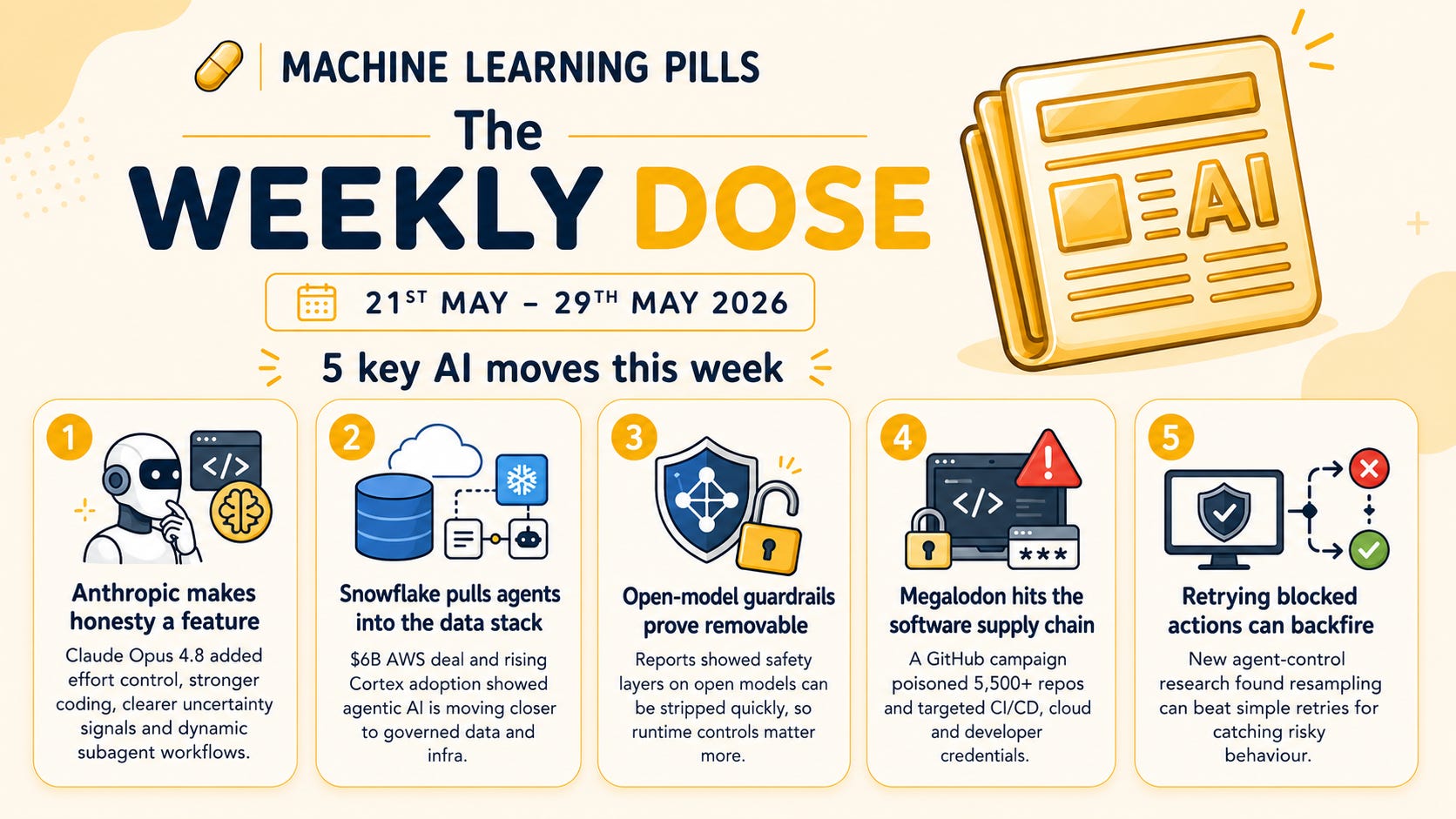
1. Anthropic made “honesty” and parallel subagents the new Claude pitch
On 28 May, Anthropic released Claude Opus 4.8, positioning it as a stronger coding, reasoning, financial-analysis, and knowledge-work model. The most interesting part was not another model version number. It was the product framing: Anthropic says Opus 4.8 is more likely to flag uncertainty and is around 4x less likely than its predecessor to let flaws in code it wrote pass unmentioned. It also added an “effort” control so users can trade off token spend against task depth.


The other serious builder signal is dynamic workflows, now in research preview. Claude can plan a larger task, run hundreds of parallel subagents in a single session, let them run longer with Opus 4.8, and verify outputs before reporting back. That is a shift from “chatbot answers question” to “model coordinates a temporary compute organisation around a task.”
The launch landed on the same day as reports that Anthropic finalised a massive funding round, with reporting from FT and Business Insider putting the raise at $65bn and the valuation close to $965bn. Treat the exact valuation as market reporting, but the practical signal is straightforward: Claude is being funded like an infrastructure company, not a chatbot company.
🫵 Why it matters to you:
For AI engineers, the important bit is not whether Opus 4.8 tops your favourite benchmark. It is that vendors are productising uncertainty signalling, effort control, verification, and multi-agent execution. Those are the knobs production teams actually need when agents touch repos, data, spreadsheets, tickets, and customer-facing workflows.
🤫 The subtext nobody says out loud:
The next frontier model battle is not just “who answers best?” It is “who gives enterprises enough control to let the model work longer, spend more, branch into subagents, and still not make a mess?”
2. Snowflake made governed data the centre of the agent stack
On 27 and 28 May, Snowflake’s AI story got very real: the company announced a $6bn, five-year AWS commitment, with reporting saying the deal gives Snowflake access to Amazon’s Graviton CPU infrastructure for agentic workloads. The framing matters because agents do not only burn GPUs for model calls. They also need lots of CPU-heavy orchestration, scheduling, data movement, query execution, and workflow glue.


Snowflake also reported Q1 revenue of $1.39bn, up roughly 33% year over year, and said adoption of products like Cortex Code and Snowflake Intelligence is helping drive AI usage across customers. One report said accounts using Snowflake Intelligence more than doubled quarter over quarter, while another noted that more than half of customers were reportedly using Cortex Code.
This is not just a stock-market story. It is a data architecture story. Enterprises do not want agents hallucinating over exported CSVs, stale vector indexes, or shadow copies of governed data. They want the agent to sit close to permissions, lineage, policy, observability, and the system of record.
🫵 Why it matters to you:
If you are building internal AI tools, your biggest bottleneck may not be the LLM. It may be whether the agent can safely act on governed data without creating a parallel, ungoverned data swamp.
🤫 The subtext nobody says out loud:
The “AI app layer” is being pulled back into the data platform. The boring warehouse vendors want to become the place where agents are allowed to think, query, and act, because that is where the controls already live.
3. Open model guardrails looked very removable
On 25 May, the Financial Times reported that tools such as Heretic are being used to strip safety protections from open models developed by Meta, Google, and others. The FT, working with AI safety group Alice, reported that modified models produced harmful responses and that the guardrails on Meta’s Llama 3.3 could be removed in less than 10 minutes without specialist hardware. The report also said Heretic had been used to create more than 3,500 “decensored” models, with modified systems downloaded 13mn times.

The technical term in the piece is abliteration, a method for weakening or removing refusal behaviour from open models. Google told the FT that this is a known technical challenge for open models and said its models go through internal safety evaluations before release. GitHub said it restricts content that directly supports unlawful active attacks or malware campaigns, while still allowing some code with educational security value.
This is the uncomfortable trade-off in open-weight AI. The same properties that make open models attractive for fine-tuning, inspection, local deployment, and cost control also make their safety behaviour easier to modify after release.
🫵 Why it matters to you:
If you use open models in production, do not treat the base model’s safety behaviour as a stable security boundary. Once weights are downloadable, downstream variants can change behaviour dramatically. Your safety layer needs to live in the product, runtime, policy engine, monitoring, and deployment controls, not only in model fine-tuning.
🤫 The subtext nobody says out loud:
“Open” and “safe” are not opposites, but they are in tension. Open models give builders control. They also give bad actors control. Pretending otherwise is not a strategy.
🛠️ Practical takeaways:
Audit which open-weight models and derivatives your systems actually call.
Pin model hashes, versions, licences, and providers rather than relying on friendly model names.
Put policy checks outside the model for dangerous outputs, tool calls, code execution, data export, and user-facing actions.
4. Megalodon showed that poisoned repos are now a CI/CD credential problem
On 25 May, TechRadar reported on Megalodon, a SafeDep-discovered campaign that infected more than 5,500 GitHub repositories with an infostealer targeting developer and CI/CD secrets. The attack reportedly used malicious commits from a fake “build-bot” account. If maintainers accepted the poisoned commits, the malware could steal AWS keys, Google Cloud tokens, cloud instance credentials, SSH private keys, Docker and Kubernetes configs, Vault tokens, Terraform credentials, and more.


The nasty part is the npm bridge. TechRadar reported that poisoned source was published downstream into npm packages, including Tiledesk versions 2.18.6 through 2.18.12, dated 19 May through 21 May. The attacker reportedly did not need to compromise the npm account directly; they compromised the GitHub repo, then the maintainer published from poisoned source.
For AI teams, this matters because coding agents, dev containers, notebooks, CI runners, and MCP servers tend to sit near exactly the credentials attackers want.
🫵 Why it matters to you:
Your AI coding workflow is part of your software supply chain now. If agents open PRs, edit workflows, install packages, run tests, or publish builds, they are not “developer productivity tools.” They are privileged automation.
🤫 The subtext nobody says out loud:
The industry spent years teaching developers to trust green checks, bots, and automation. Attackers noticed.
🛠️ Practical takeaways:
Review recent bot-authored and drive-by commits before release.
Rotate secrets if affected repos, packages, or CI runners touched sensitive environments.
Require provenance checks from source commit to package artefact.
Treat agent-generated PRs like untrusted external contributions until reviewed.
5. “Retry the blocked action” is not a complete agent safety strategy
On 25 May, James Lucassen and Adam Kaufman published Retrying vs Resampling in AI Control on arXiv. The paper studies a pattern already used in coding scaffolds such as Claude Code and Codex: when a risky action is blocked, the system retries and lets the agent continue. The authors argue that retrying can reduce honest suspicion scores, but can also let an untrusted model learn from monitor rationale and construct sneakier attacks.
Their alternative is resampling: draw multiple candidate actions from the same context without leaking monitor feedback. In BashArena, using Claude Opus 4.6 as the untrusted model and MiMo-V2-Flash as the trusted monitor, drawing five samples per step and auditing on the maximum suspicion score raised safety from 61% to 71% at a 0.3% audit budget, with no usefulness loss reported. Selective resampling recovered 6.2 percentage points of gain while drawing only 10% as many extra samples.
This is exactly the kind of boring control detail agent builders need more of. The model may be brilliant, but the runtime is where the blast radius is decided.
🫵 Why it matters to you:
If your agent framework blocks suspicious shell commands, file writes, data exports, or API calls, think carefully about what feedback the model receives after a block. Monitor rationale can become training material for evasion inside the same task.
🤫 The subtext nobody says out loud:
Agent safety is becoming less like prompt engineering and more like adversarial systems design. The monitor is not just a judge. It is part of the game board.
🛠️ Practical takeaways:
Do not expose detailed security rationale to the same agent that triggered the block.
Compare retrying, resampling, approval gates, and hard termination in your own agent traces.
Audit on the riskiest candidate action, not only the action the agent finally chooses.
Log blocked attempts as security events, not harmless model noise.
💡 Our take
This week’s theme is simple: control is moving out of the prompt and into the runtime.
Anthropic is turning effort, uncertainty, verification, and subagent orchestration into product controls. Snowflake is trying to make governed data the home base for enterprise agents. The FT’s guardrail-stripping story shows why safety cannot live only inside open weights. Megalodon shows that repos and CI/CD are now part of the AI attack surface. The resampling paper shows that even your safety monitor can become an attack surface if it explains too much.
The model still matters. But the model is no longer where most production risk lives.
The key signals from this week:
Native agent orchestration is becoming a vendor feature, not a hackathon pattern.
Governed data platforms are trying to absorb the AI application layer.
Open-weight deployment needs external safety controls, not just trust in post-training.
Developer automation is now privileged infrastructure.
Agent safety needs runtime design, not nicer refusal prompts.
The better question is no longer “which model should we use?”
It is: where does the agent get authority, what can it touch, who verifies it, and what happens when it tries something risky?
📌 Your to-do list
Audit every agent workflow that can write files, run shell commands, publish packages, send messages, query production data, export data, or mutate configs.
Re-test coding agents on uncertainty behaviour: do they flag weak evidence, failed tests, partial fixes, and suspicious assumptions?
Move high-risk agent actions behind deterministic approval gates, not model self-approval.
Review dependency provenance from repo commit to package artefact, especially where bot-authored commits are accepted.
Pin open-model variants by hash and provider, then add runtime policy checks outside the model.
Benchmark Snowflake, Databricks, BigQuery, and warehouse-native AI features on permissioning, lineage, cost per workflow, latency, and observability.
Update your agent security tests to include blocked-action retries, monitor-feedback leakage, and resampling-based alternatives.
See you next week.