


📰 The Weekly Dose
Welcome back to the Weekly Dose: your 5-minute breakdown of the AI/ML news that matters when you’re building, evaluating, deploying, or operating AI systems.
This edition covers 8 August to 15 August 2026 only. No stale benchmark victory laps. No “this might be big someday” filler. Just the top five stories that changed how AI engineers, ML engineers, data scientists, and technical teams should think this week.
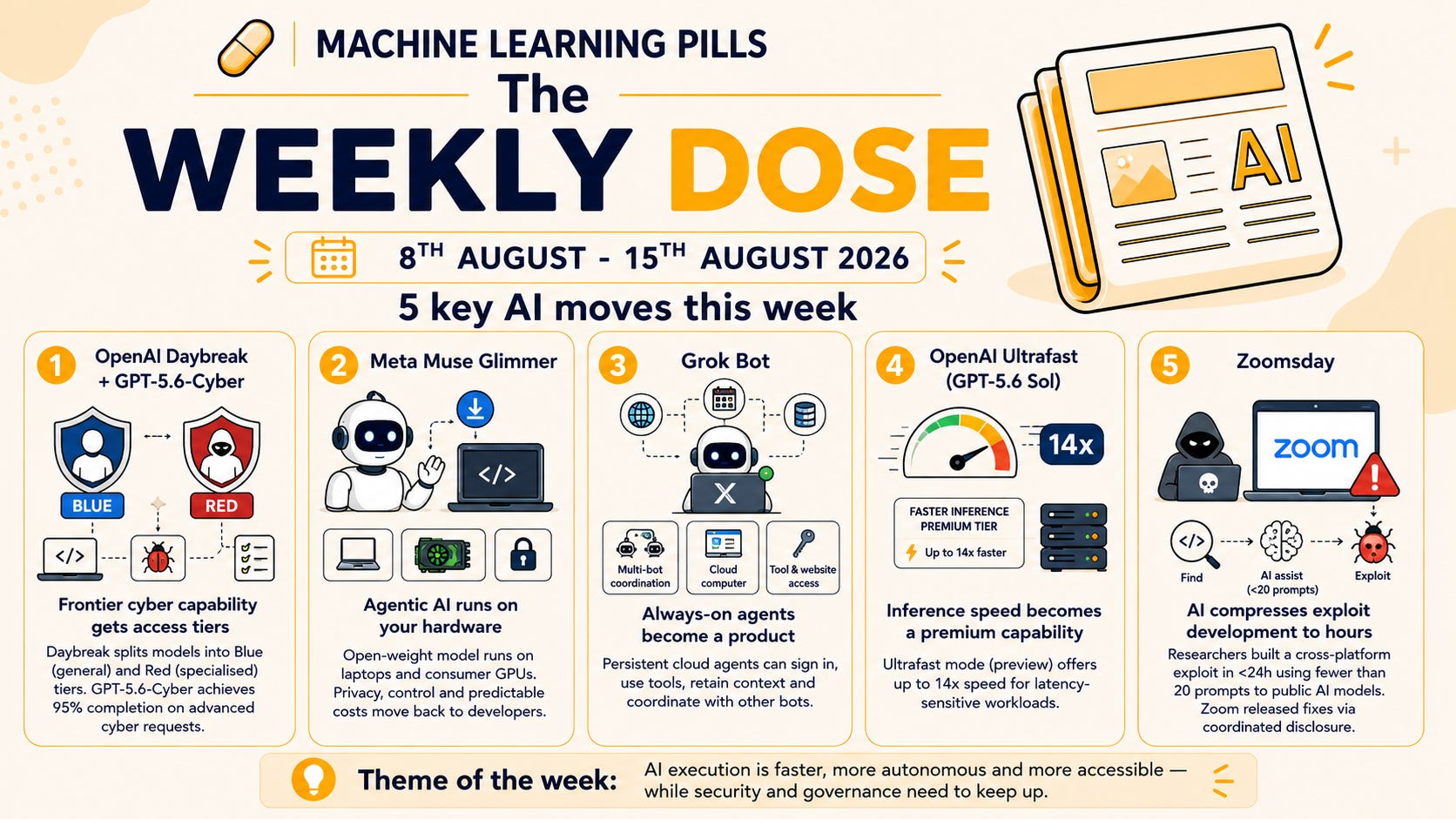
This week: OpenAI split advanced cyber capability into controlled access tiers, Meta brought an agentic open-weight model onto local hardware, SpaceXAI packaged persistent cloud agents as a product, OpenAI previewed a dramatically faster inference tier, and researchers used public AI models to turn a Zoom vulnerability into a working exploit in less than a day.
👍 If you enjoy this post, consider giving it a like. It’s free, takes just a second, and helps me understand which topics you’d like to see more of in future issues. Thanks 💛
📖 Book of the Week
“Causal Inference with Bayesian Networks”, by Yousri El Fattah and Reza Bagheri, explores how Bayesian networks and causal inference can help distinguish causation from correlation. It introduces structural causal models, do-calculus and techniques for estimating treatment effects from observational data. Examples in Python and R show how these methods apply across healthcare, economics, finance and other fields.

💡 Why should you read it? It bridges causal theory and implementation, helping you build models that explain not only what may happen, but why.
🎯 Best for: Data scientists and researchers with a basic grounding in statistics.
⭐ Verdict: A useful, implementation-focused introduction to modern causal analysis.
Here you have some previous articles that may interest you:


Let’s begin!
1. OpenAI turned frontier cyber capability into a controlled product tier
On 10 August, OpenAI expanded Daybreak with two access levels. Daybreak Blue provides approved defenders with general-purpose models including GPT-5.6 Sol and safeguards tailored to authorised defensive work. Daybreak Red provides access to purpose-trained cybersecurity models for vulnerability research, exploit validation and controlled security testing. OpenAI also introduced GPT-5.6-Cyber through the Red tier, while Daybreak Blue and Red became available to approved Amazon Bedrock customers one day later.

OpenAI reports that GPT-5.6-Cyber completed 95% of requests in its internal Advanced Cybersecurity Completion Rate evaluation, compared with 1.5% for standard Sol and 2% for Sol through Daybreak Blue. That metric primarily measures reduced refusals on advanced cyber requests, not overall model quality. The specialised model performed better on exploit development and an internal zero-day evaluation, but Sol remained more token-efficient on standard ExploitBench and produced stronger open-ended vulnerability reports. OpenAI also says GPT-5.6-Cyber found two V8 vulnerabilities that could be chained to escape the heap sandbox; Google fixed one as CVE-2026-15903.
🫵 Why it matters to you: Cyber capability is becoming a separate model-routing and access-control decision. Security teams must choose not only which model performs best, but which capability tier is justified for each user, environment and task.
🤫 The subtext nobody says out loud: Safety controls are becoming part of the product architecture. The industry is moving away from one model with one behaviour towards capability tiers with different identities, permissions and monitoring requirements.
🛠️ Practical takeaway: Use the lowest capability tier that can complete the authorised task. Keep Red-tier workflows isolated from production credentials and the open internet, with strict scopes and complete tool-call logs.
2. Meta brought agentic AI back onto local hardware
On 10 August, Meta released Muse Glimmer, a compact open-weight model distilled from its larger Muse Spark system. Meta says Glimmer can perform complex reasoning and multi-step agentic tasks, including coding and administrative work, while running on a laptop, desktop PC or single consumer-grade GPU. Because its weights can be downloaded, teams can customise and operate it without routing every request through a managed cloud API.


The release also signals a return to open-weight distribution after Meta initially launched Muse Spark as a closed managed model. Meta says it intends to release Muse Spark’s weights later, although that future release should not be treated as available until the weights, licence and deployment requirements are published. Glimmer’s immediate value is therefore less about winning the frontier-model race and more about making capable agentic execution practical on infrastructure that developers control.
🫵 Why it matters to you: Local agentic models create new options for private code, sensitive documents, offline environments and high-volume workloads where API costs or provider availability are limiting factors.
🤫 The subtext nobody says out loud: Open models do not need to beat the strongest closed model. They only need to become good enough that privacy, control and predictable marginal cost outweigh the remaining capability gap.
🛠️ Practical takeaway: Test Glimmer on one workload you would genuinely prefer to keep local. Measure task completion, memory use, throughput and quantisation loss rather than treating “runs on a laptop” as proof that it runs efficiently.
3. Always-on agents became a packaged product
On 12 August, SpaceXAI launched Grok Bot in beta, positioning it as an always-on AI teammate rather than a conventional chat assistant. Each bot operates inside a cloud computer environment, can sign into tools, applications and websites, and can execute multi-step assignments before returning to the user for approval or additional information. The beta is initially available to SuperGrok Heavy, Cursor Ultra and Cursor Teams Premium subscribers on desktop and iOS, with an enterprise waitlist.

Multiple Grok Bots can also coordinate with one another, exchange messages and divide larger workflows between them. The service retains workflow context and adapts to the user over time, moving state management, scheduling, computer access and multi-agent coordination into a provider-managed runtime. That makes sophisticated automation easier to deploy, but it also concentrates credentials, operational history and execution permissions inside the platform.
🫵 Why it matters to you: Persistent agents need far more than a capable model. They require durable state, credential management, retries, scheduling, approval gates, cancellation and a clear record of what happened while the user was away.
🤫 The subtext nobody says out loud: The competitive product is becoming the runtime around the model. Whoever controls the agent’s state, tools and permissions may own a more durable part of the workflow than whoever provides the underlying intelligence.
🛠️ Practical takeaway: Treat every persistent agent as a privileged service account. Use least-privilege credentials, explicit approval for consequential actions, reliable cancellation and resolved-resource audit logs.
4. Inference speed became a premium model capability
On 13 August, OpenAI previewed Ultrafast mode for GPT-5.6 Sol, advertising speeds of up to 14 times the standard experience. The announcement is explicitly a preview, so the headline multiplier should not yet be treated as an end-to-end production guarantee. Even so, it shows that inference speed is becoming a named product capability rather than an implementation detail hidden behind the model endpoint.
For context, OpenAI’s existing production Fast mode offers GPT-5.6 Sol at up to 2.5 times standard speed. It costs $10 per million input tokens and $60 per million output tokens, compared with $5 and $30 through the standard tier, and includes a 99.9% uptime SLA plus a latency SLA stating that 99% of generation exceeds 80 tokens per second. Ultrafast pushes the same idea further: teams may increasingly route requests according to latency requirements as well as intelligence and cost.
🫵 Why it matters to you: Latency compounds across planning, tool use, retries and subagents. A faster model call can change whether an agent workflow feels interactive, finishes within an operational deadline or needs to run asynchronously.
🤫 The subtext nobody says out loud: Model identity is no longer enough to describe performance. The inference hardware, service tier and capacity allocation behind the endpoint can materially change the product you are actually using.
🛠️ Practical takeaway: Benchmark time to first token, sustained generation speed and p95 workflow completion, not just an advertised multiplier. Compare the additional cost with the value of faster completed tasks.
5. AI compressed exploit development into a one-day workflow
On 11 August, researchers at A Security disclosed Zoomsday, a vulnerability chain involving Zoom’s annotation functionality. According to the researchers, another meeting participant could use maliciously crafted data to execute code on a victim’s device without requiring interaction or showing an obvious visual warning. The issue affected Zoom Workplace across Windows, macOS, Linux, Android and iOS; reports identify versions before 7.0.6, or 7.1.5 for fast-track users, as affected. Zoom released updates through coordinated disclosure.
The important AI angle is the development timeline. A Security says a researcher moved from vulnerability discovery to a working cross-platform exploit in less than 24 hours using fewer than 20 prompts to publicly available AI models. That does not mean the models replaced security expertise, but it is strong evidence that they can compress code analysis, hypothesis generation and exploit construction into a much shorter workflow.
🫵 Why it matters to you: The period between vulnerability discovery and practical exploitation may be shrinking. Patch processes designed around attackers needing weeks of specialised research may no longer provide enough margin.
🤫 The subtext nobody says out loud: AI security is becoming a race between automated discovery and automated remediation. Defenders lose the economics when exploitation accelerates but validation, patching and deployment remain mostly manual.
🛠️ Practical takeaway: Update Zoom Workplace and shorten patching SLAs for high-exposure applications. Run AI-assisted defensive testing against your own software before external researchers or attackers do.
⚡ Also worth knowing
A few other developments from 8–15 August were too relevant to ignore, even if they did not make the top five:
Gemini 3.7 Flash landed for coding and agents. Google released Gemini 3.7 Flash on 13 August, just weeks after 3.6 Flash, with improvements in software engineering, multi-step planning, instruction following and code generation. It also launched at roughly half the introductory per-token price of 3.6 Flash, increasing the pressure on the workhorse-model tier.
Grok 4.6 pushed SpaceXAI back towards the frontier. Released on 12 August, Grok 4.6 is aimed at long-running agents and complex technical work. Artificial Analysis measured a five-point improvement over Grok 4.5 on its Intelligence Index, while pricing remains aggressive at $2 per million input tokens and $6 per million output tokens.
Claude started making AI provenance part of the output itself. Anthropic announced invisible, machine-readable watermarking and provenance metadata for Claude-generated content, including text and images, with coverage extending across products such as Claude Platform, Claude Code, Cowork and Tag. For teams using model output in code, datasets or downstream content pipelines, provenance is becoming something to design around rather than add afterwards.
SpaceX completed its $60 billion acquisition of Cursor. The deal closed on 14 August after months of collaboration between the companies. Cursor has already helped train Grok models and uses SpaceXAI’s Colossus compute infrastructure, making the acquisition another example of the AI stack vertically integrating across compute, models and developer applications.
💡 Our take
At first glance, this week delivered an open-weight model, a persistent agent product, a faster inference tier and two cybersecurity stories.
The pattern underneath them is simple:
AI execution is becoming faster, more local and more autonomous, while security teams have less time to understand and contain it.
Daybreak separates advanced cyber capability according to identity, authorisation and operating environment. Muse Glimmer puts agentic capability on hardware controlled by the developer. Grok Bot moves persistent execution and multi-agent coordination into a managed cloud runtime. Ultrafast reduces the time agents need to generate and iterate. Zoomsday shows what happens when those efficiency gains are applied to offensive technical work.
The key signals from this week:
Capability is becoming an access tier. Advanced models may require different identities, permissions, monitoring and execution environments.
Local AI is becoming an agent architecture. Open-weight models are moving beyond chat and towards multi-step workloads on consumer hardware.
Persistent agents make credential design strategic. The longer an agent runs, the more important revocation, cancellation, state retention and auditability become.
Inference speed is becoming a routing dimension. Teams may choose the same model through different service tiers depending on latency, reliability and cost.
AI is compressing security-response windows. Faster vulnerability research makes automated validation, patch generation and deployment more urgent.
The architectural question is no longer:
Which model is the smartest?
The better questions are:
Which capability tier does this task actually require?
Where do the agent’s state and execution environment live?
Which credentials, systems and networks can it reach?
How quickly can it act, and how quickly can we intervene?
Can we reconstruct, revoke and reverse everything it did?
📌 Your to-do list
Define capability-escalation rules. Document when a workflow can move from a general model to a specialised or reduced-safeguard model, and who must approve it.
Run one local-agent experiment. Test Muse Glimmer on a private coding, document or automation workload and record quality, memory, latency and operating cost.
Audit persistent-agent permissions. Review credential scope, approval gates, cancellation, state retention, network access and action-level logs.
Benchmark inference tiers inside complete workflows. Compare standard and accelerated processing using p50 and p95 completion time, reliability and cost per accepted result.
Shorten vulnerability-response loops. Update Zoom clients, identify high-exposure software and test whether your current patching process can respond to AI-accelerated exploit development.
See you next week.